
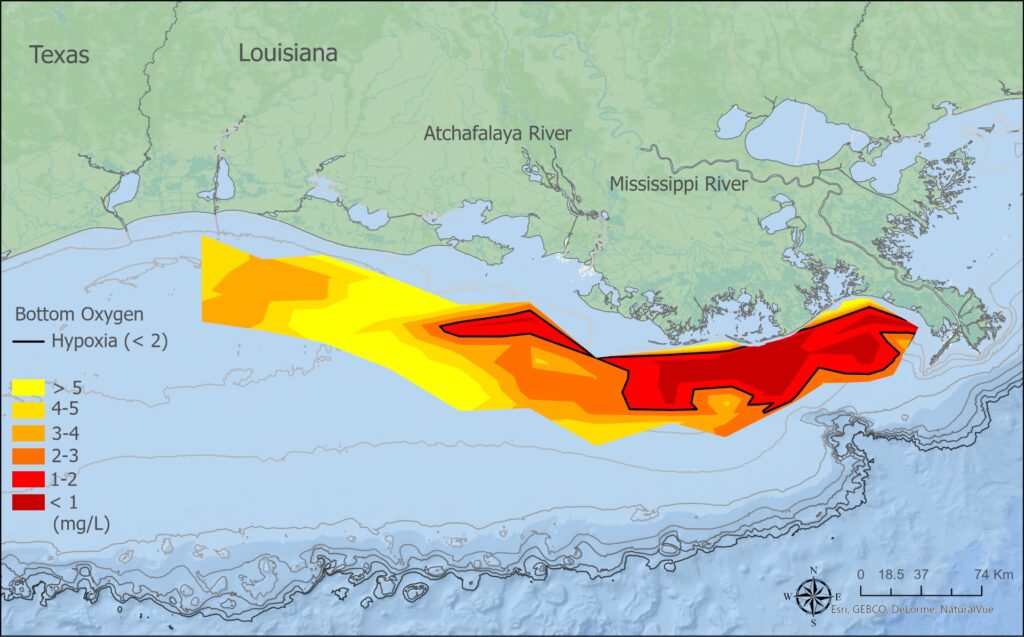
What is hypoxia?
Hypoxia, or low oxygen, is an environmental phenomenon where the concentration of dissolved oxygen in the water column decreases to a level that can no longer support living aquatic organisms. Hypoxic areas, or “Dead Zones,” have increased in duration and frequency across our planet’s oceans since first being noted in the 1970s.
The largest hypoxic zone currently affecting the United States, and the second largest hypoxic zone worldwide, is the northern Gulf of Mexico adjacent to the Mississippi River.
Gulf hypoxia in the news:
NOAA and partners announce below-average ‘dead zone’ measured in Gulf of Mexico
Tyler Wittkofsky | NOAA 2 August 2023 Today, NOAA-supported scientists announced that this year’s Gulf of Mexico “dead zone”— an area of low to no oxygen that can kill fish and marine life — [...]
NOAA forecasts below-average summer ‘dead zone’ in Gulf of Mexico
Tyler Wittkofsky | NOAA 5 June 2023 NOAA is forecasting a summer “dead zone” in the Gulf of Mexico that will cover approximately 4,155 square miles, making it below the 5,364 square mile average over [...]
Study finds climate change is bringing more intense rains to U.S.
Atmospheric scientists noted the trend was prevalent in nearly every region of the country. Matthew Cappucci | The Washington Post 11 October 2022 When it rains, it pours. A paper published Tuesday in the journal [...]
Giant seaweed blob twice the width of the US takes aim at Florida
Rachel Tucker | The Washington Post 13 March 2023 TAMPA, Fla. (WFLA) — Marine scientists are tracking a 5,000-mile-wide seaweed bloom that is so large, it can be seen from space. These sargassum blooms [...]
‘Dead zone’ smaller than expected, but bigger than desired
Joshua Rosenberg | The Lens 3 AUGUST 2022 The so-called dead zone where the Mississippi River dumps into the Gulf of Mexico, an area of low oxygen that cannot sustain life, clocked in at 3,275 [...]
Gulf dead zone smaller this year, but still five times size of Lake Pontchartrain
Mark Schleifstein | NOLA.com 3 August 2022 Scientists measuring the low-oxygen dead zone in the Gulf of Mexico this summer found a mix of good and bad news: It covered only 3,275 square miles [...]
To reduce harmful algal blooms and dead zones, the US needs a national strategy for regulating farm pollution
Donald Boesch & Donald Scavia | The Conversation 18 July 2022 Midsummer is the time for forecasts of the size of this year’s “dead zones” and algal blooms in major lakes and bays. Will the [...]